



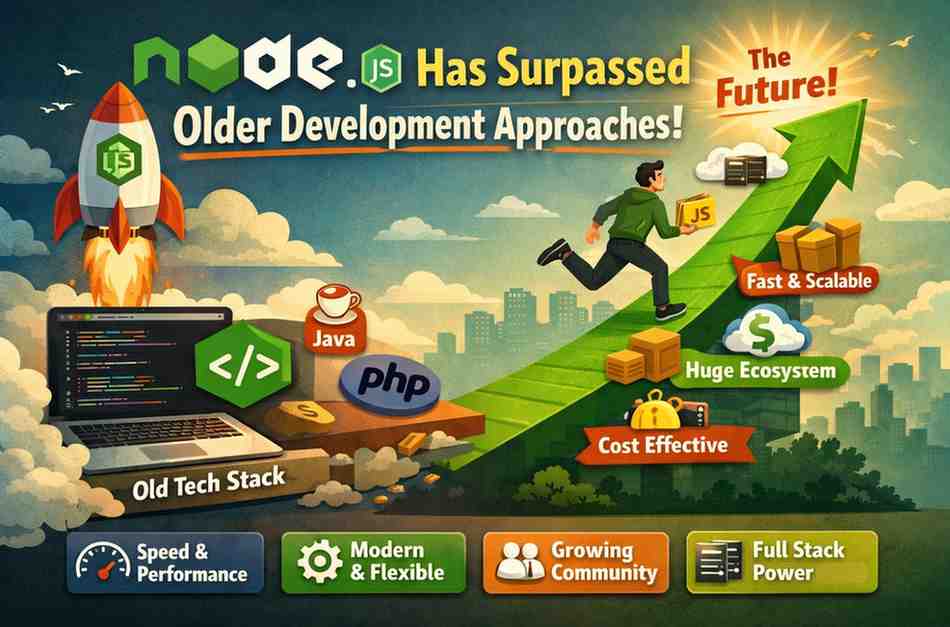
Why NodeJS Has Surpassed Older Development Approaches
Web development has changed significantly over the last decade. Businesses today expect faster applications, real time features, seamless scalability, and lower operational costs. Older server side technologies were built in a different era, when applications were simpler and user expectations were lower. This shift in demand is the key reason why NodeJS Web Development has emerged as a preferred choice over traditional development models.
This article analyzes why NodeJS has replaced older approaches and how it delivers measurable value to modern businesses.
Limitations of Older Server Side Technologies
Traditional web development platforms like early PHP frameworks, ASP.NET Web Forms, and synchronous Java based servers followed a blocking I O model. Each request consumed a dedicated thread, which limited performance under heavy traffic. As user loads increased, applications became slower and harder to scale.
Another challenge was fragmented development. Frontend and backend were often built using different languages and teams, which increased development time and communication gaps. Maintenance also became costly, as small changes required multiple layers of coordination.
For businesses, these limitations translated into delayed launches, higher infrastructure costs, and difficulty supporting real time features like live chat, notifications, or streaming.
Event Driven Architecture of NodeJS
NodeJS introduced an event driven, non blocking architecture that changed how servers handle requests. Instead of creating a new thread for every user action, NodeJS processes multiple requests using a single event loop. This allows applications to stay responsive even during high traffic periods.
From a business standpoint, this means better performance without proportional increases in server costs. Applications built with NodeJS Web Development can support thousands of concurrent users while maintaining speed and stability.
This architecture is particularly valuable for applications that rely on continuous data exchange, such as collaboration tools, dashboards, and messaging platforms.
Faster Development with JavaScript Everywhere
One of the biggest advantages NodeJS has over older platforms is the use of JavaScript across the entire application stack. Developers can write frontend and backend code in the same language, reducing context switching and simplifying workflows.
Shared code libraries, reusable modules, and unified tooling help teams build features faster and with fewer errors. Businesses benefit from shorter development cycles, quicker updates, and easier onboarding of developers.
By choosing NodeJS Web Development, organizations gain agility. This is crucial in competitive markets where speed to launch and continuous improvement directly impact revenue.
Scalability for Growing Businesses
Older systems often required vertical scaling, which meant upgrading servers to handle more users. This approach was expensive and had clear limits. NodeJS, on the other hand, is designed for horizontal scaling.
NodeJS applications can be easily distributed across multiple servers or cloud instances. They integrate smoothly with modern cloud platforms and container based architectures. This allows businesses to scale gradually based on demand rather than making large upfront investments.
For startups and enterprises alike, this flexibility reduces risk and ensures that the technology grows alongside the business.
Rich Ecosystem and Community Support
NodeJS benefits from one of the largest open source ecosystems in the world. The Node Package Manager provides access to thousands of ready made modules for authentication, payments, analytics, and more.
This ecosystem significantly reduces development effort compared to older technologies, where custom solutions were often required. Regular updates, strong community support, and enterprise level backing make NodeJS a future ready choice.
Clients benefit from stable applications, faster feature additions, and reduced dependency on proprietary tools.
Real Time Capabilities as a Standard
Modern users expect instant updates. Whether it is order tracking, live notifications, or collaborative editing, real time interaction is no longer optional. Implementing these features on older systems required complex workarounds and third party tools.
NodeJS handles real time communication natively using technologies like Web Sockets. This makes it ideal for applications where responsiveness and user engagement are critical.
Businesses adopting NodeJS can deliver better user experiences without adding unnecessary complexity to their systems.
Conclusion
The shift from older development approaches to NodeJS is driven by real business needs, not trends. Performance, scalability, faster development, and real time capabilities are essential for modern digital products. NodeJS addresses these needs with a flexible, efficient, and developer friendly architecture.
For organizations looking to build scalable, future ready applications, NodeJS Web Development offers a clear advantage over legacy technologies, helping businesses stay competitive, reduce costs, and deliver better digital experiences.