


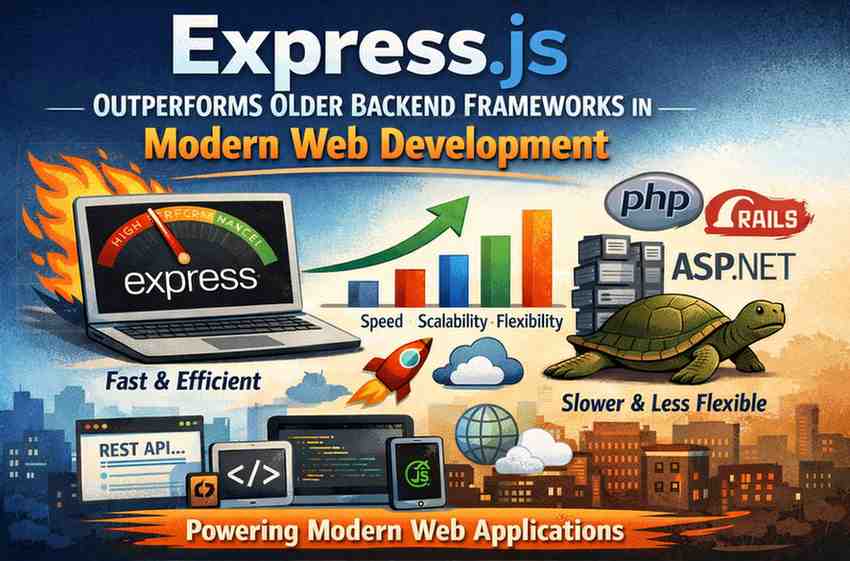
Why Express.js Outperforms Older Backend Frameworks in Modern Web Development
Web development has changed significantly over the past decade. Businesses today expect faster load times, scalable architectures, real-time features, and seamless user experiences across devices. Older backend frameworks were not built with these expectations in mind. This is where Express.js Web Development has clearly positioned itself as a modern, efficient, and business-ready solution.
Express.js is a lightweight and flexible Node.js framework that simplifies backend development while offering high performance and scalability. Compared to legacy backend frameworks and early server-side solutions, Express.js delivers clear advantages that align with today’s digital demands.
Evolution from Traditional Backend Frameworks
Older backend frameworks often relied on monolithic architectures, heavy configuration files, and tightly coupled components. While they served their purpose in earlier web eras, they struggle to meet modern requirements such as API-first development, microservices, and real-time communication.
In contrast, Express.js was designed for speed, simplicity, and adaptability. It embraces minimalism, allowing developers to add only what is necessary. This approach reduces complexity, improves maintainability, and accelerates development cycles, which directly benefits businesses looking to launch products faster.
Performance and Speed Advantages
Performance is one of the strongest reasons businesses move away from older frameworks. Traditional systems often process requests sequentially, which limits their ability to handle high traffic efficiently.
Express.js leverages Node.js’s non-blocking, event-driven architecture. This allows applications to handle thousands of concurrent requests without slowing down. For businesses, this means faster response times, smoother user experiences, and the ability to scale without major infrastructure changes.
This performance advantage makes Express.js Web Development ideal for high-traffic platforms such as e-commerce websites, SaaS products, and real-time applications.
Simplified Development and Maintenance
Legacy frameworks often require extensive boilerplate code and rigid structures, making development slow and error-prone. Even small updates can require changes across multiple files, increasing maintenance costs.
Express.js offers a clean and intuitive structure. Routing, middleware, and request handling are straightforward and easy to manage. Developers can focus on business logic rather than framework limitations. This results in faster development, fewer bugs, and easier long-term maintenance.
For organizations, this translates into reduced development costs and quicker updates when market needs change.
Modern API-First and Microservices Support
Modern applications are rarely standalone systems. They connect with mobile apps, third-party services, payment gateways, and cloud platforms. Older frameworks were not originally designed for API-centric architectures, which can make integration difficult.
Express.js excels in building RESTful APIs and microservices. It integrates seamlessly with JSON, authentication systems, and external services. This makes it easier for businesses to expand functionality, integrate new tools, and future-proof their applications.
Companies adopting Express.js Web Development gain flexibility that older backend technologies struggle to offer.
Strong Ecosystem and Community Support
One of the biggest limitations of older frameworks is declining community support. Fewer updates, limited plugins, and outdated documentation can slow down development and increase security risks.
Express.js benefits from the massive Node.js ecosystem. Thousands of open-source packages are available through npm, allowing developers to add features like authentication, logging, validation, and security with ease. Regular updates and active community support ensure that applications stay secure and up to date.
For businesses, this means long-term reliability and access to modern development tools without reinventing the wheel.
Scalability for Growing Businesses
Scalability is a major concern for any growing organization. Many older frameworks require significant refactoring or hardware upgrades to handle increased traffic.
Express.js scales efficiently, especially when combined with cloud platforms and container technologies. Whether a business starts small or operates at enterprise scale, Express.js adapts smoothly to growth. This makes it a smart investment for startups and established companies alike.
By choosing Express.js Web Development, businesses ensure that their applications can grow alongside their customer base without performance bottlenecks.
Security and Compliance Improvements
Security expectations have evolved rapidly. Older frameworks may lack built-in protections against modern threats or require complex configurations to meet compliance standards.
Express.js supports modern security practices through middleware and community-driven tools. Features such as input validation, authentication, rate limiting, and secure headers are easy to implement. This helps businesses protect sensitive data and meet regulatory requirements more effectively.
Conclusion
The shift from legacy backend frameworks to modern solutions is no longer optional. Businesses need performance, scalability, flexibility, and faster time to market. Express.js delivers all of this through a lightweight architecture, strong ecosystem, and modern development approach.
Compared to older frameworks, Express.js provides better performance, easier maintenance, seamless API integration, and long-term scalability. For organizations looking to build future-ready applications, Express.js Web Development stands out as a reliable and strategic choice.