


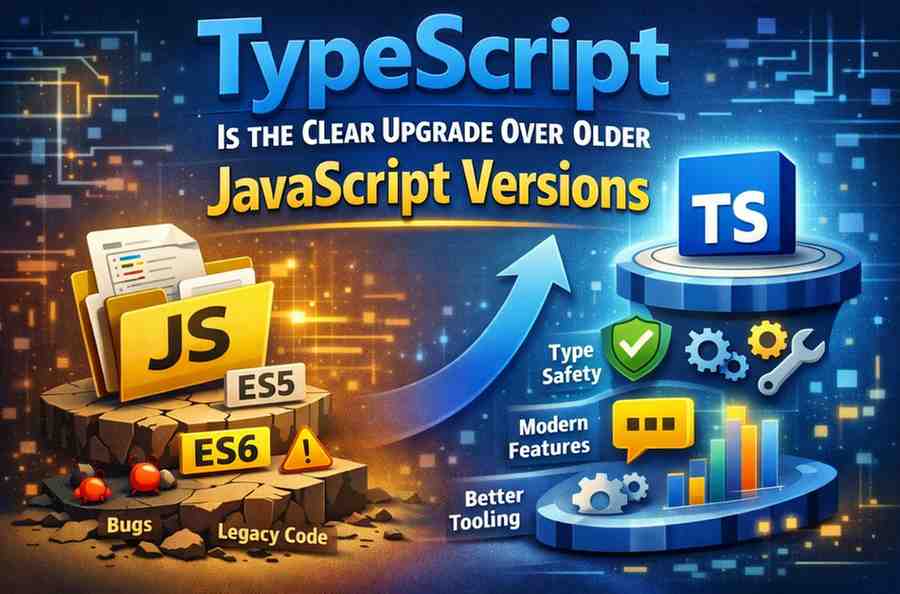
Why TypeScript Is the Clear Upgrade Over Older JavaScript Versions
Web development has evolved rapidly over the last decade. As applications have grown more complex, the limitations of older JavaScript versions have become more visible. Issues like runtime errors, weak scalability, and maintenance challenges pushed developers to look for better solutions. This is where TypeScript stepped in and redefined modern frontend and backend development. Today, TypeScript Web Development is widely considered a practical and future-ready upgrade over traditional JavaScript.
The Limitations of Older JavaScript Versions
JavaScript was originally designed to handle small scripts and simple browser interactions. Older versions lacked strict structure, making it easy to write code but hard to manage at scale. As projects grew, teams often faced unexpected runtime errors, inconsistent code patterns, and poor readability.
Debugging was also a major concern. Errors would surface only after execution, often in production environments. For businesses, this meant higher costs, delayed releases, and unstable user experiences. While frameworks tried to fill these gaps, the core language itself needed improvement.
TypeScript Brings Structure Without Sacrificing Flexibility
TypeScript builds on JavaScript by adding static typing, interfaces, and modern tooling support. The key advantage is that developers can catch errors during development rather than after deployment. This alone saves time, effort, and money.
Unlike older JavaScript versions, TypeScript allows teams to define clear contracts between components. Variables, functions, and APIs follow predictable rules. Yet, it does not restrict flexibility. Any valid JavaScript code runs seamlessly in TypeScript, making adoption smooth and low risk.
For organizations upgrading legacy systems, TypeScript Web Development offers a balanced approach. Teams can migrate gradually while continuing to deliver features.
Improved Code Quality and Maintainability
One of the strongest reasons TypeScript outperforms older JavaScript versions is maintainability. Typed code is easier to understand, especially in large teams. New developers can read type definitions and instantly grasp how data flows through the system.
Refactoring also becomes safer. With older JavaScript, changing a function could break multiple areas without warning. TypeScript highlights these issues during development. This leads to cleaner codebases, reduced technical debt, and longer software lifespans.
From a customer perspective, better maintainability means faster updates, fewer bugs, and more reliable applications.
Better Tooling and Developer Productivity
TypeScript integrates deeply with modern IDEs and editors. Features like intelligent autocomplete, inline documentation, and real-time error detection dramatically improve developer productivity.
Older JavaScript versions relied heavily on manual testing and debugging. TypeScript reduces this burden by acting as a safety net. Developers spend less time fixing avoidable errors and more time building meaningful features.
For businesses, this translates into faster development cycles and predictable delivery timelines. Projects stay on budget and scale efficiently as requirements grow.
Stronger Support for Modern Frameworks
Most modern frameworks and libraries now prioritize TypeScript. Angular was built with TypeScript at its core, and React, Vue, and Node.js ecosystems provide first-class TypeScript support.
Using TypeScript with these frameworks improves consistency and performance. It aligns frontend and backend development under a single, strongly typed language. This consistency was difficult to achieve with older JavaScript versions.
As a result, TypeScript Web Development has become the preferred choice for enterprise-grade applications and long-term digital products.
Enhanced Scalability for Growing Businesses
Scalability is not just about handling more users. It also involves managing growing teams, features, and integrations. Older JavaScript versions often struggled in this area due to loose structure and unpredictable behavior.
TypeScript provides a scalable foundation by enforcing standards across the codebase. Teams can define shared models, reusable components, and consistent APIs. This makes collaboration smoother and reduces onboarding time for new developers.
For customers, scalable architecture means applications that grow smoothly without frequent rewrites or performance issues.
Security and Reliability Advantages
While TypeScript is not a security tool by itself, it significantly reduces common errors that lead to vulnerabilities. Type mismatches, undefined values, and incorrect API usage are flagged early.
Older JavaScript versions allowed these issues to slip into production unnoticed. TypeScript improves reliability by preventing many of these mistakes before the application goes live.
More reliable software builds trust with users and protects brand reputation in competitive markets.
Conclusion
TypeScript is not just an upgrade to JavaScript. It is a practical response to the challenges modern web applications face. By addressing the limitations of older JavaScript versions, it delivers better code quality, improved scalability, and higher development efficiency. For businesses looking to build stable, future-ready applications, TypeScript Web Development offers a clear, customer-focused advantage that aligns technology with long-term growth goals.