




Why React Native Is a Smarter Choice Over Older Framework Versions
Technology evolves fast, and web and app development is no exception. Businesses that still rely on older development frameworks often face rising maintenance costs, slower performance, and limited scalability. This is where React Native stands out. Built and maintained by Meta, React Native has matured into a reliable, future ready framework that solves many of the challenges associated with older versions of web and mobile development technologies.
This article explores why React Native is a better choice compared to older frameworks, with a clear focus on performance, cost efficiency, developer productivity, and long term business value, especially in the context of React Native Web Development.
Limitations of Older Development Frameworks
Older frameworks such as legacy JavaScript libraries, early hybrid platforms, or outdated native stacks were built for a different era of devices and user expectations. While they served their purpose, they now struggle to meet modern demands.
Common issues include slower rendering, higher memory usage, limited component reusability, and inconsistent user experience across platforms. From a business perspective, this often results in higher development costs, longer release cycles, and difficulty integrating with modern APIs and tools.
Customers today expect fast loading, smooth interfaces, and consistent behavior whether they are using web, Android, or iOS. Older frameworks simply were not designed with this level of cross platform consistency in mind.
React Native’s Modern Architecture Advantage
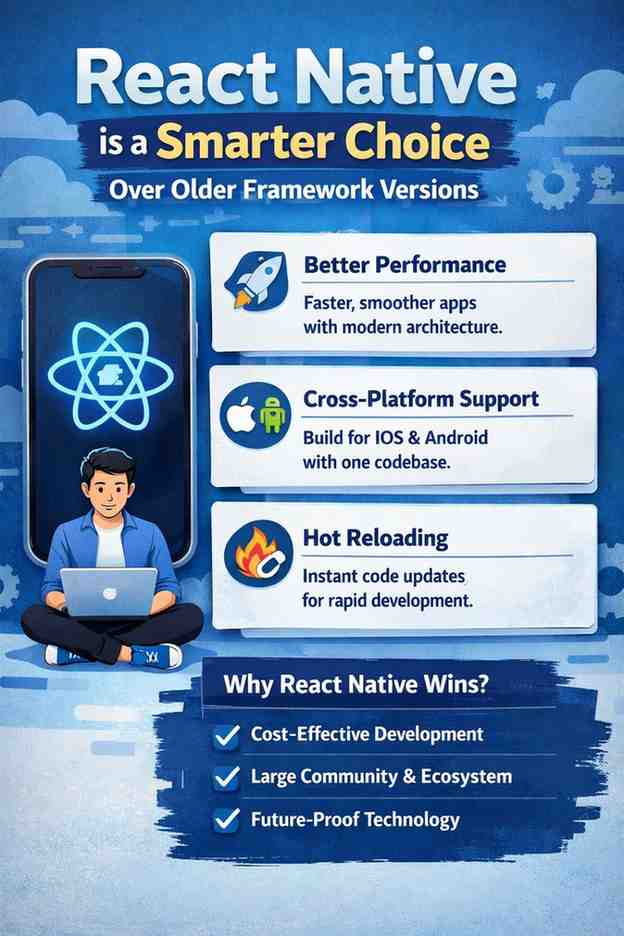
React Native introduces a component based architecture that significantly improves how applications are built and maintained. Unlike older frameworks that rely heavily on web views or duplicated codebases, React Native allows developers to write a single codebase that runs across multiple platforms.
This modern approach makes React Native Web Development especially appealing for businesses looking to unify their web and mobile strategy. The framework bridges native components directly, resulting in better performance and smoother animations compared to older hybrid solutions.
For customers, this translates into apps that feel fast, responsive, and intuitive, without the lag often associated with legacy technologies.
Faster Development and Lower Costs
One of the biggest business advantages of React Native over older versions is development speed. Features like hot reloading allow developers to see changes instantly, reducing development and testing time.
Older frameworks often require separate teams for web and mobile development. React Native eliminates this duplication by allowing shared logic and components. This directly reduces development costs, simplifies maintenance, and shortens time to market.
For customers, faster development means quicker access to new features, regular updates, and better overall product stability. Businesses can respond faster to customer feedback without rebuilding entire systems.
Consistent User Experience Across Platforms
Consistency is critical for customer trust. Older frameworks often produce different UI behaviors on different platforms, which leads to confusion and frustration.
React Native uses native UI components, ensuring the application looks and behaves like a true native app on each platform. This consistency is a major reason why React Native Web Development is increasingly adopted by companies aiming to deliver seamless digital experiences.
From login flows to navigation and performance, users experience the same quality regardless of device, which strengthens brand perception and customer satisfaction.
Strong Ecosystem and Long Term Support
Many older frameworks suffer from limited community support or are no longer actively maintained. This creates risks related to security updates, compatibility, and future scalability.
React Native benefits from a massive global community, frequent updates, and backing from Meta. Thousands of open source libraries, tools, and integrations are readily available, making it easier to extend functionality without reinventing the wheel.
For customers, this means more stable applications, better security, and confidence that the platform will continue to evolve with industry standards.
Easier Maintenance and Scalability
Maintenance is where older frameworks often become costly. Codebases grow complex, documentation becomes outdated, and scaling the application requires major rewrites.
React Native’s modular structure simplifies maintenance and allows teams to scale features incrementally. New functionalities can be added without disrupting existing workflows.
This scalability ensures that businesses can grow their digital products alongside customer demand, without facing the technical debt common in older systems.
Conclusion
React Native is not just a replacement for older frameworks, it is a strategic upgrade. It addresses the performance, scalability, and cost challenges that legacy technologies struggle with today. By adopting React Native, businesses gain faster development cycles, consistent user experiences, and long term reliability.
For organizations focused on delivering modern, high quality digital solutions, React Native Web Development offers a future proof path that aligns technology with customer expectations and business growth.