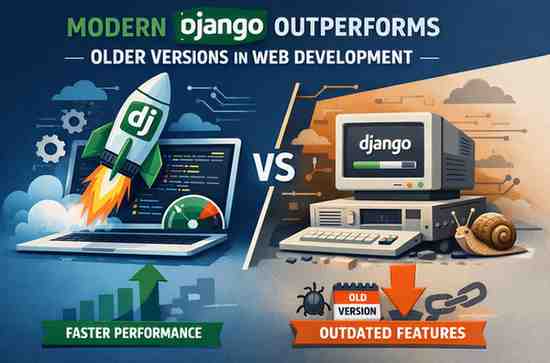
Why Modern Django Outperforms Older Versions in Web Development Why Modern Django Matters Over the past two decades, Django Web Development has evolved from a niche Python tool to one of the most reliable and scalable frameworks for building web applications. Originally open‑sourced in 2005, Django’s early releases focused on solving practical, newsroom‑driven problems: rapid content updates, reusable components, and straightforward database interaction. Today, it’s used by companies such as Instagram, Pinterest, Mozilla and others, which speaks to its maturity and adaptability. The framework’s philosophy hasn’t shifted dramatically since its inception. It still emphasizes clean code, security by default and a comprehensive set of built‑in tools that let developers focus on business logic rather than boilerplate. What has changed is how the framework embraces newer patterns, performance improvements and scalability demands that older versions simply weren’t built to address. What Older Versions Offered In the early days of Django, releases such as 1.0 and 1.2 laid the groundwork for what the framework would become. Django 1.0 was the first stable version that dropped the “beta” tag after years of development. It introduced a revamped admin interface, improved template escaping, better Unicode support and a foundational file storage system. This era was defined by two priorities: Making web development fast. Django was one of the first frameworks to include so much out of the box, reducing the need for developers to add plugins for basic capabilities like authentication, ORM and admin panels. Improving security and stability. Even early versions included protection against common vulnerabilities, a practice that remains core to the framework today. While these releases were ground breaking for their time, they had limitations. Performance optimization was basic compared to what modern platforms demand. Asynchronous tasks, native async support and other modern web patterns were not part of the core. The community filled many gaps with third‑party packages, but relying on external tools often made projects harder to maintain. What Modern Django Brings to the Table Fast forward to the Django of today. The framework continues to evolve while keeping its core values intact. Recent versions include enhanced asynchronous handling, modern ORM improvements and refined tools that support large, traffic‑heavy applications. According to community reports, newer releases are pushing deeper async capabilities, improved form rendering and a more efficient database query system that weren’t possible in older versions. From a customer perspective, the benefits are clear: 1. Improved performance and scalability Modern Django can handle more complex workloads while minimizing response times. Developers now get better async support out of the box, making apps more responsive and capable of handling concurrent operations without blocking. 2. Consistent security updates One of Django’s strengths has always been its security focus. While older versions had basic defenses against threats like SQL injection and CSRF, newer releases keep pace with emerging vulnerabilities. Security patches and fixes are regularly released, ensuring long‑term support and trust. 3. Cleaner development experience The “batteries‑included” philosophy remains, but tools have become more polished. From a more intuitive ORM to improved error reporting and debugging features, modern Django strips away much of the frustration developers once faced. This translates to faster iteration cycles and better code quality for customers. 4. Ecosystem maturity Older versions relied heavily on third‑party tools for features like timers, task queues and advanced caching. Today those integrations are more stable and better documented. Some capabilities, such as asynchronous views and modern form handling, are now supported by Django’s core without needing external dependencies. Why Upgrading Matters for Your Business If you’re building or maintaining a web application, sticking with older Django versions can hold you back. Here’s why: Security: Older releases eventually reach end of life and stop receiving patches. This exposes your application to risk and compliance issues. Performance: Modern user expectations demand speed. Improvements in async handling, database efficiency and caching can reduce load times and keep users engaged. Developer Productivity: Teams familiar with the latest Django features can deliver new modules faster, with less technical debt. This affects project timelines and total cost of ownership. Future‑proofing: The web is constantly changing. Staying current with Django versions means smoother transitions to emerging frontend frameworks, APIs, DevOps practices and cloud deployments. In contrast, older versions were limited in handling modern demands. They required workarounds for async tasks, didn’t optimize for high concurrency and lacked many of the built‑in efficiencies developers take for granted now. These differences become more apparent in complex apps or in those expected to scale quickly. Balancing Legacy with Innovation Some teams still run older Django versions for legacy reasons. Migration can be nontrivial, especially in large codebases with custom middleware or tightly‑coupled modules. The key is to evaluate both technical debt and future needs. Planning upgrades incrementally, reviewing release notes and refactoring code incrementally can make the transition smoother. Conclusion Across its lifespan, Django Web Development has grown from a solid but simple framework to a robust, scalable engine powering modern web applications. While older versions were remarkable for their time and shaped how web development evolved, current releases bring meaningful enhancements in performance, security and developer productivity. For businesses that care about reliability, maintainability and future growth, choosing modern Django is not just a technical decision, it’s a strategic investment in long‑term success. Django Web Development remains a compelling option for any web project.
